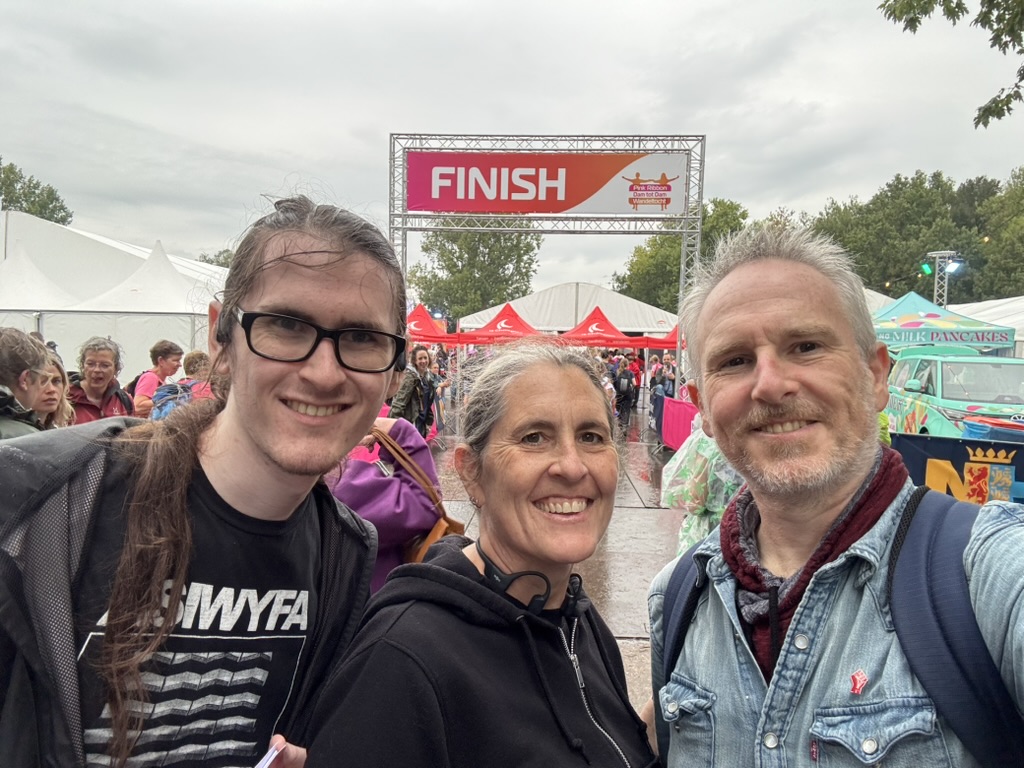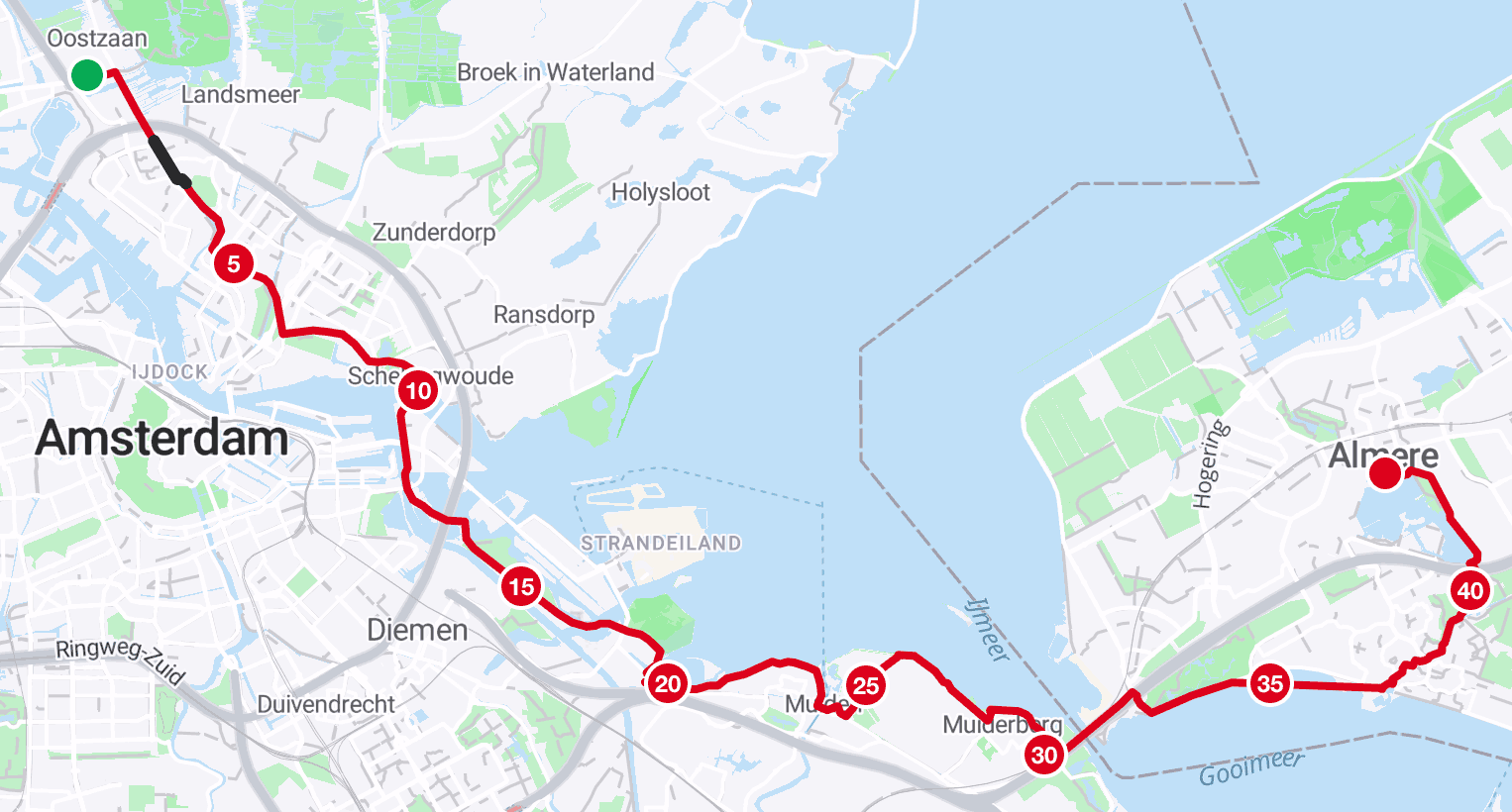
Distance 43.4km, actual walking time 7h 29m, total elapsed time 8h 12m. (Last year: 42.4km, 7h 25m, 8h 29m respectively.) Compared to last year, one kilometer more distance in an extra 4 minutes, but fewer breaks, so a better pace overall. Nice! On the walk I felt that this year was a little slow, but that was clearly just in my head. Annual self-check: passed ✅.
Minimal blisters, one on the ball of each foot because I didn’t tape them up quickly enough when I felt the hot spots emerging. (Must do better.) I’m writing this on Sunday evening, a day later, and the stiffness is pretty much gone from my legs now. My knees were feeling a bit painful on the walk between 30 and 35km, but an ibuprofen was enough to knock that on the head. Still some knee twinges today, but nothing to stop me from going up and down stairs. That said, I did spend pretty much the whole day today just lying on the sofa reading a book (A Deadly Episode by Anthony Horowitz), which felt like a delicious luxury.
Looking back at what I wrote last year, I see some similarities and some differences. Last year I was feeling stressed at work: same this year, but different reasons. Last year I was still relatively new in the job; this year it’s just been super busy with deadlines. Despite that, I’ve been getting out for a lunchtime walk most days. I just feel better when I get daily exercise; and I’ve also been enjoying the birds and paying attention to the progress of spring. It felt like a long dark winter, and everyone in the house is particularly enjoying the return of longer days. Last year I was not looking forward to doing the annual marathon, but this year I was very happy to get out. I’d been waiting for a good Saturday: something with the right weather conditions: not too cold, not too hot, not too windy. Turns out that 25 April is the perfect date.

The route I took this year was eastward to Almere on Flevoland. I’ve been to Almere a few times before, but always by car. It’s a weird place. It’s a terraforming experiment on our doorstep. The whole province of Flevoland is reclaimed land and literally didn’t exist a hundred years ago. The city of Almere is only 50 years old. The first house wasn’t built until the 1970s, but now it has a population of over 200,000, with a bustling centre and a ton of well-established residential neighbourhoods. It feels like a Dutch city…but walking around in the centre, it also feels somewhat artificial because it doesn’t have any old bits. And yet it’s surrounded by farmland, new woodlands, beaches, and all the trappings of a medium-sized city.
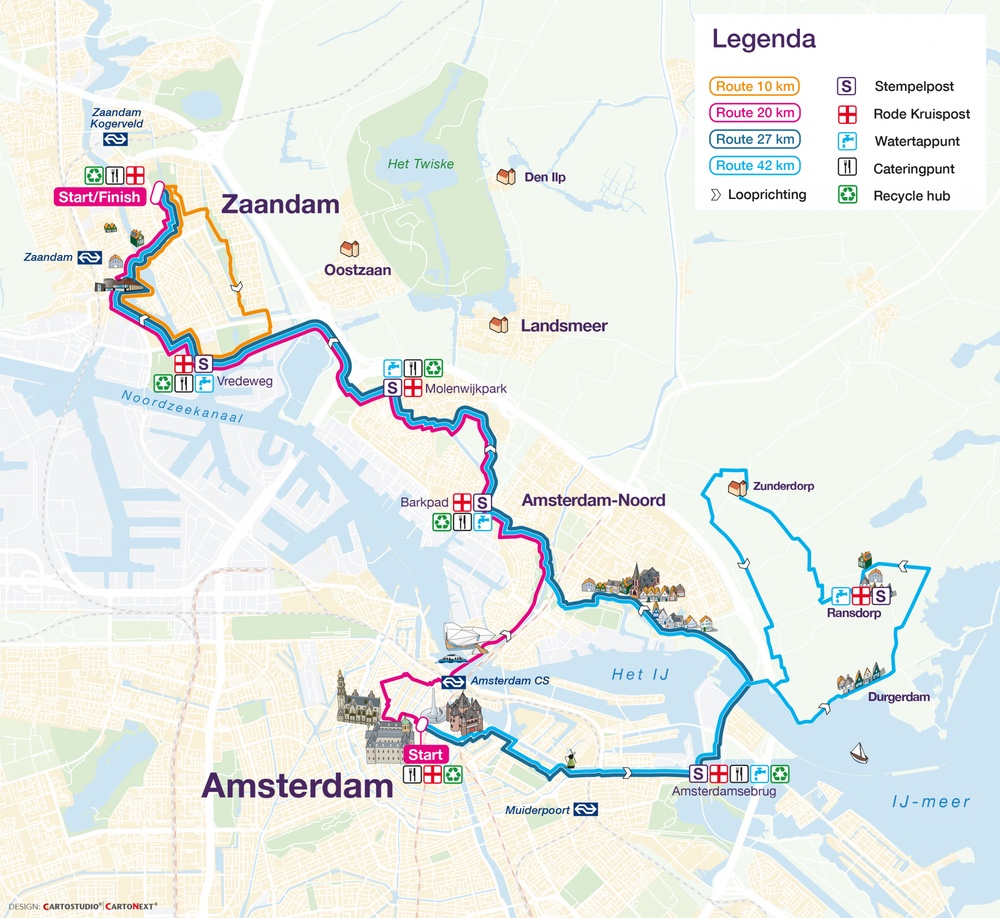
I set off at about 06:45 and took mostly the same route as the Dam-tot-Dam walk to Schellingwoude. On other walks I’ve crossed the IJ river on the Schellingwouderbrug, but I wanted to do something different this year, and I crossed over the Oranjesluizen locks instead.
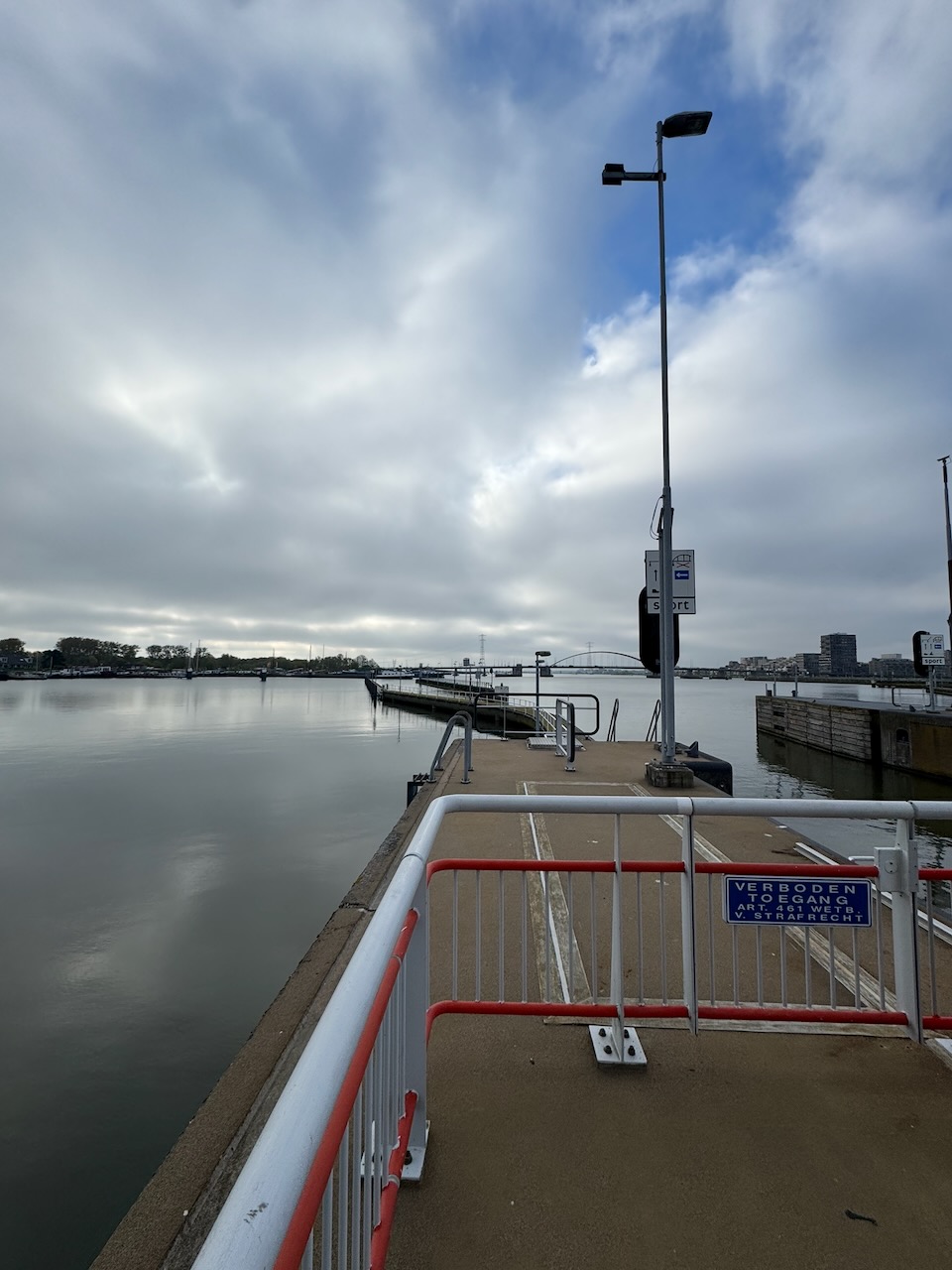
This was about 10km into the route, and it was still cold – the day had started around 6°C. Texting an update to various chat channels took care and attention because my fingers were quite stiff. But the clouds were dispersing, and by the time I made it to the Diemerpark an hour later the sun was out. Just as in other recent years, I did this year’s walk with minimal gear: no backpack, just me, my shoes, a fleece, and lots of pockets. So I didn’t have anywhere to stash layers if I got too warm.
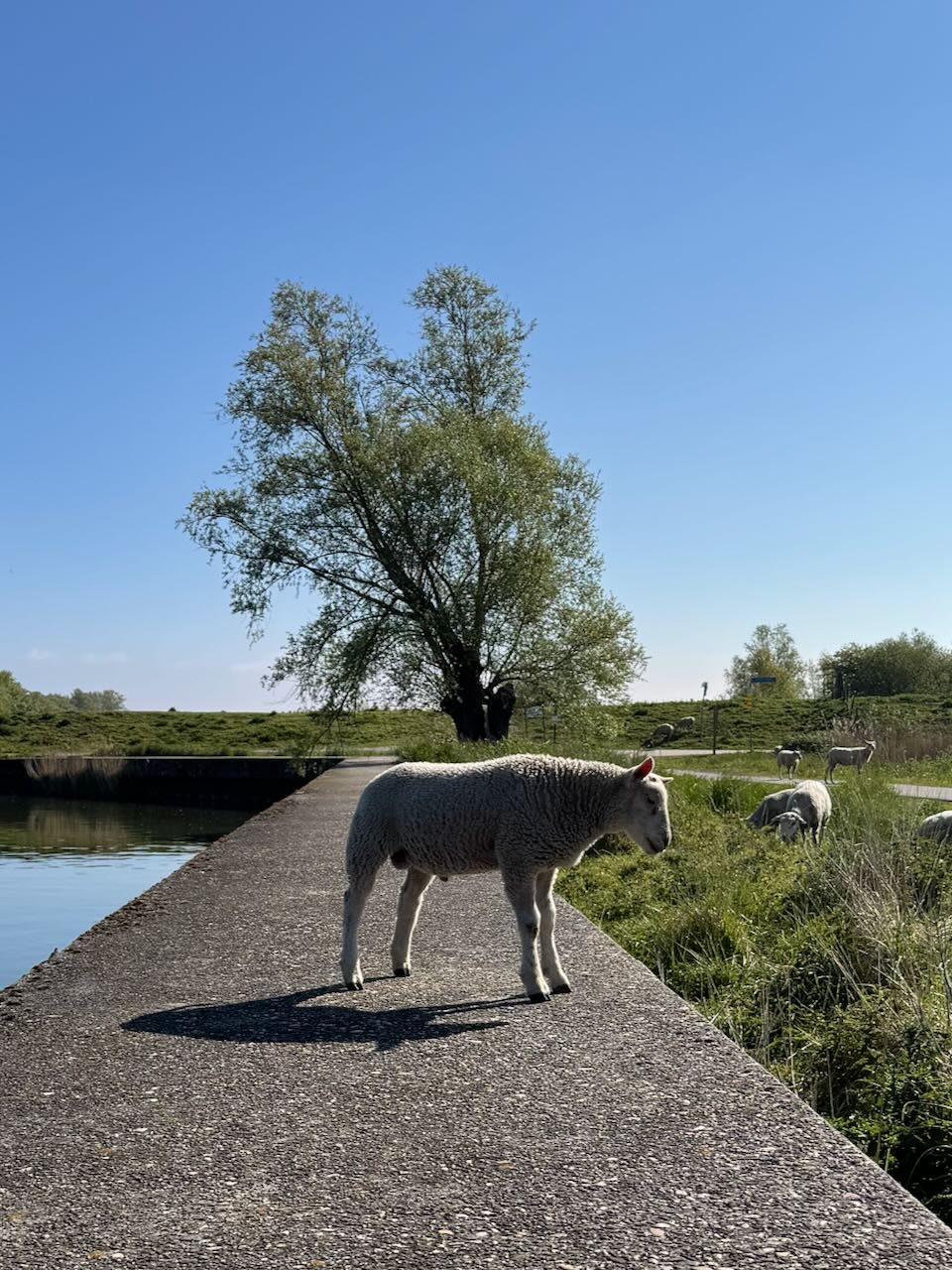
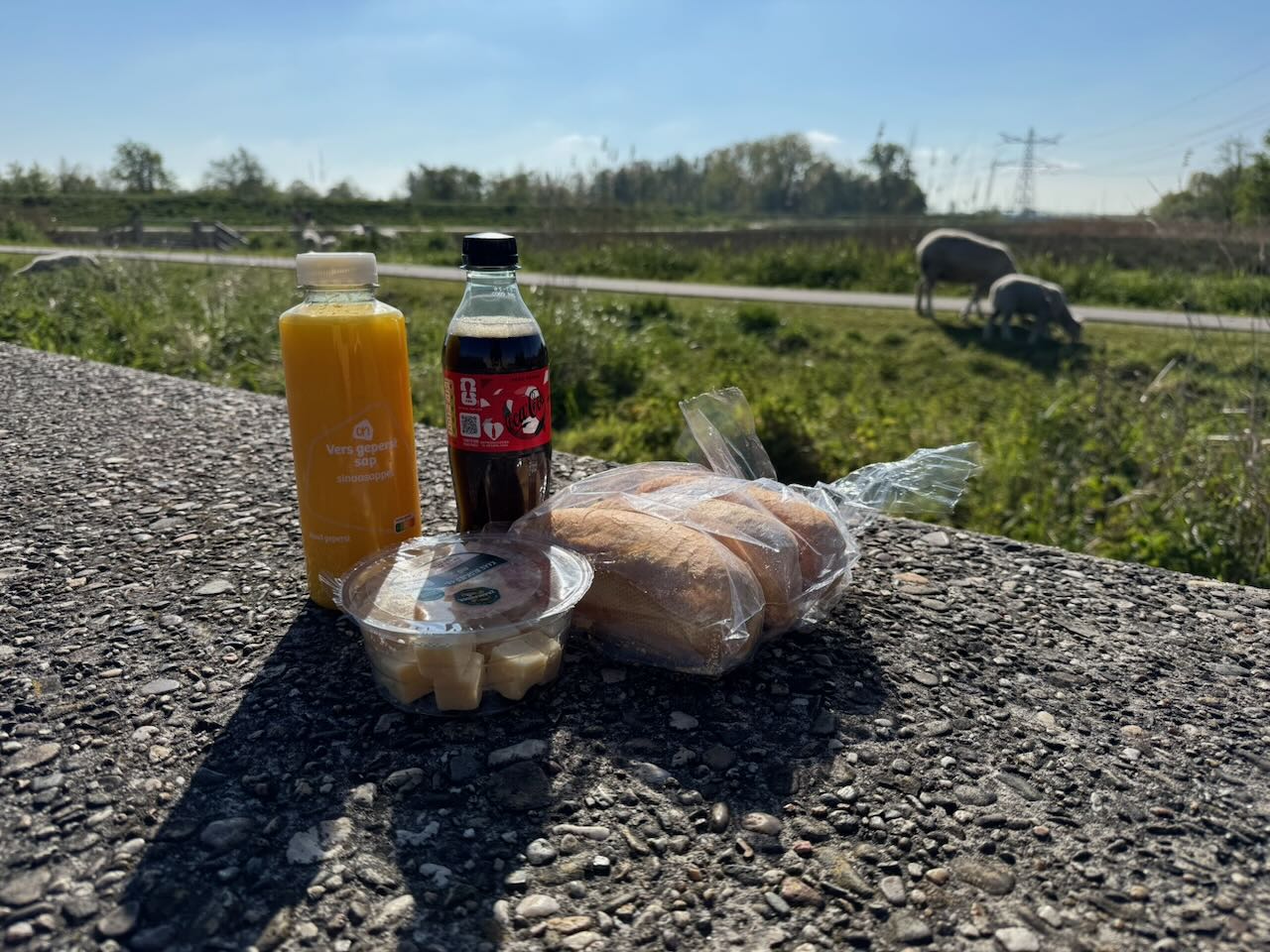
The Diemerpark is also recently reclaimed land. (There’s a pattern here.) It’s flat and straight, and full of rabbits. Just past the park, a little short of the 20km mark, I took a slight detour to the Maxis shopping centre to buy myself some breakfast. Last year I had a friendly coot for company at breakfast; this year I sat on a concrete wall next to the water and was joined by a fearless lamb.
After my break I took he coastal path to Muiden, crossed the locks in the centre of town, and then continued on the coastal path to Muiderberg. It’s a lovely path, with views of Flevoland and its giant wind turbines in the distance. But it was also full of flies. The air was thick with them wherever the plants grew tall along the verges. No amount of swatting was enough to clear a path. I was brushing them off my fleece and spitting them out of my mouth at regular intervals. The barn swallows were having a great time swooping and snatching them, but as a walker I think I would have preferred a bit more of a breeze to keep them away.
I had saved up some podcast episodes for listening on the walk. Some 99% Invisible, of course. Also some Articles of Interest, Decoder Ring and Imaginary Worlds. On the long boring bridge across the Gooimeer to Flevoland I was listening to the episode “Holmes and Watson: True Crime Podcasters”, which was fun. I’m not a big fan of scripted audio drama or audiobooks. I don’t know why. But I appreciate the effort that goes into them, and this sounds like a fun new twist on the Conan Doyle stories.
I took another rest break on the other side of the bridge, at about 33km. The next leg was another long flat stretch along the south edge of the polder to Almere Haven. Just as the Diemerpark had been full of rabbits, the water here was full of grebes. SO MANY GREBES.
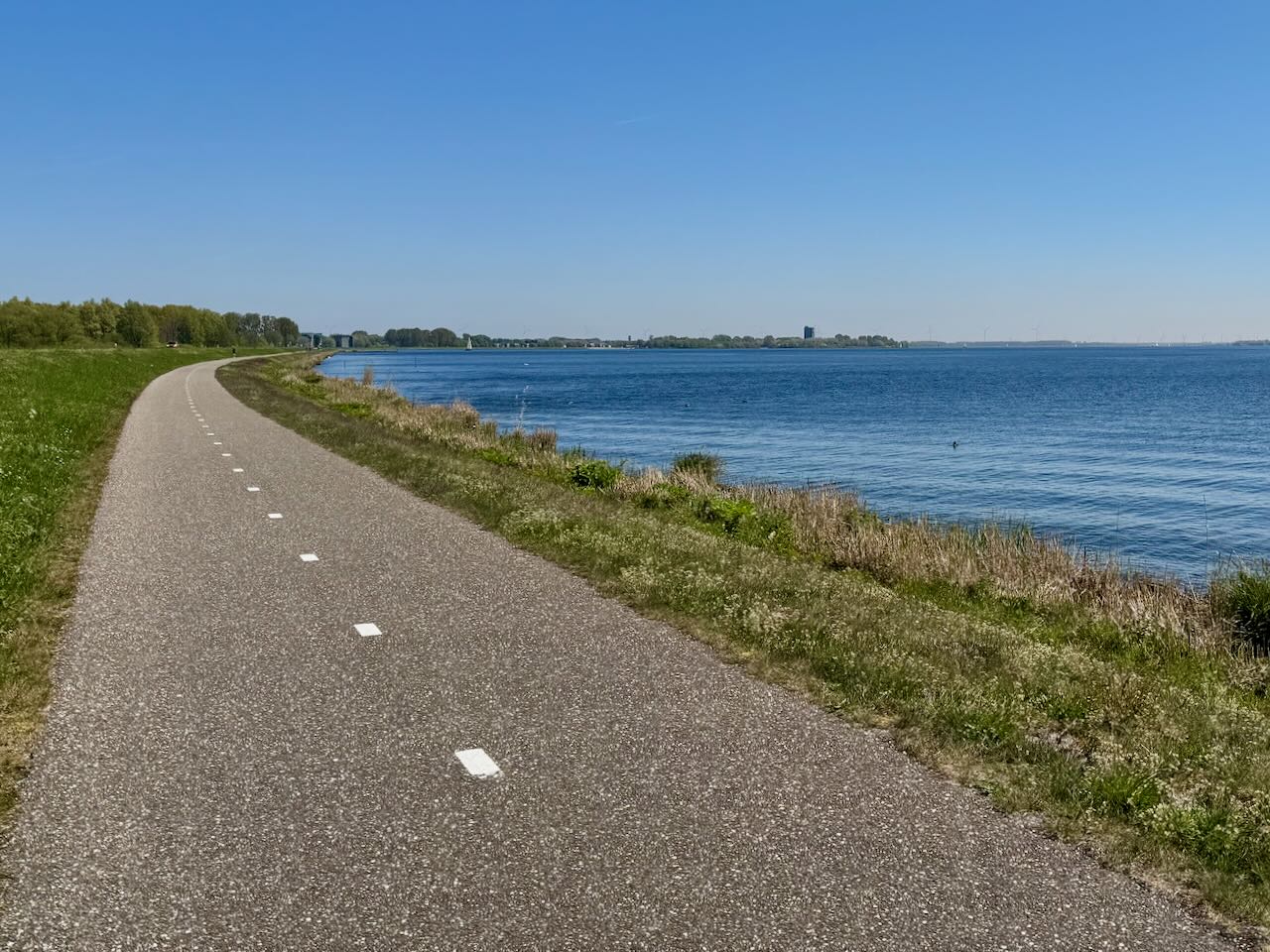
I took my last break at the edge of the marina in Almere Haven. I messaged Abi to let her know I was about an hour away from finishing. The route from Almere Haven to Almere took me past one of the most incongruous sights on the whole of Flevoland, which is itself nothing but a giant incongruity: the ruins of Almere Castle.
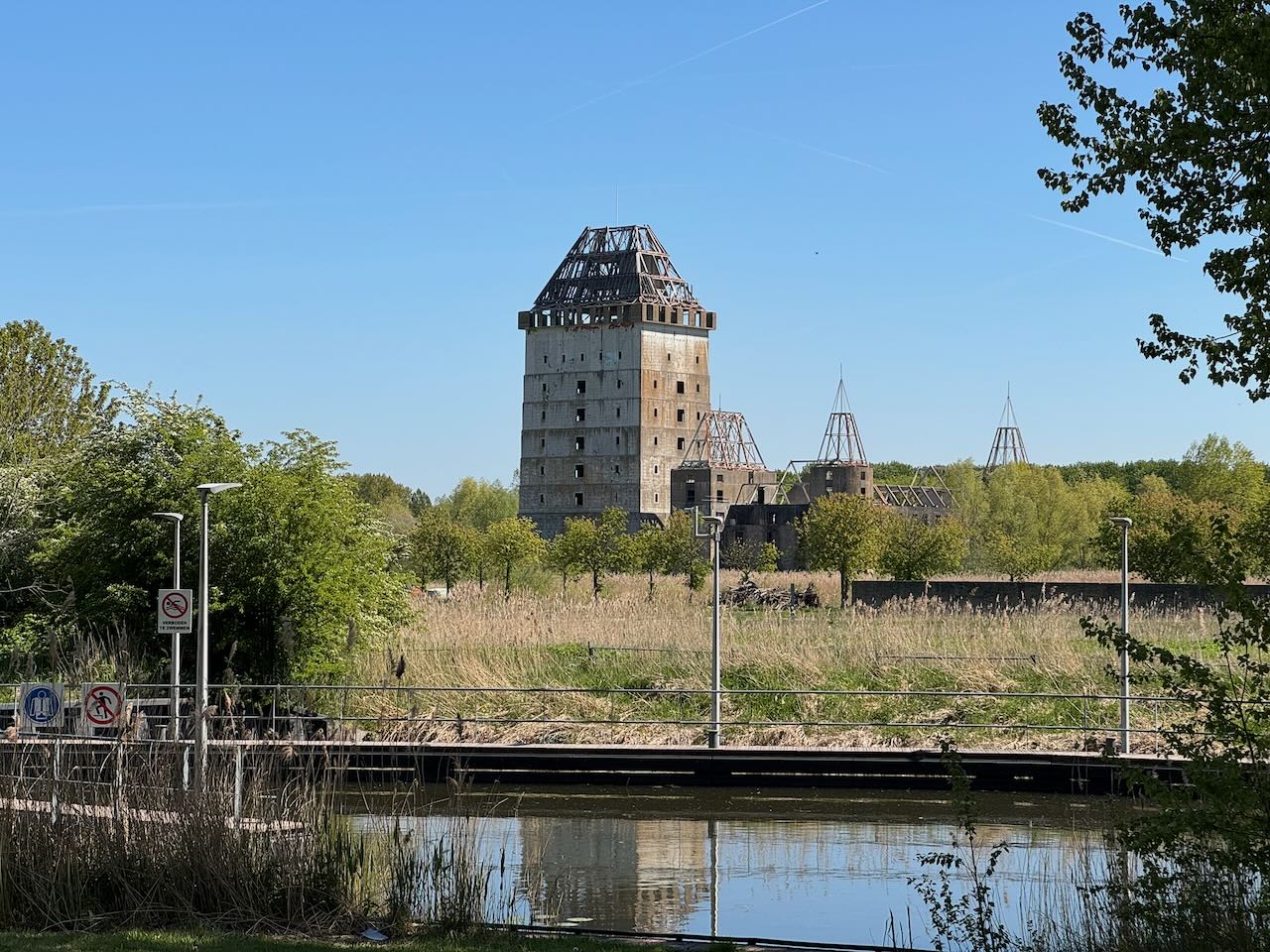
If you’re thinking to yourself, “hang on, didn’t he just say that the area has only been inhabited for 50 years?” — yes. Yes indeed. This isn’t a castle that has fallen into disrepair over the centuries. It’s a modern folly that was started in 1999, and never finished in the first place. Construction was abandoned in 2002. Since then, various parties have tried to find ways to make it financially viable so they could finish it, but no luck so far. You can catch glimpses of it from the A6 motorway. If you’re used to driving the highways and byways of Europe, it looks pretty normal: “oh look, it’s another castle ruin.” It’s only when you take a moment to think about it that it stops making sense. Go Netherlands!
I made it to the Esplanade next to the lake in the centre of Almere at almost exactly 15:00, feeling tired but not done in. Abi was on her way to pick me up. There are plenty of places to sit and have a coffee in the city centre, but I wasn’t really feeling the vibes. We decided that Abi would pick me up, and we’d drive somewhere else to have our customary end-of-walk coffee/drink and apple pie.
The marina in Almere Haven had seemed nice, and had plenty of cafés with terraces out front. We drove there, parked, wandered up to the marina, found a café with apple pie on their menu, and settled ourselves at a table with a nice view. When the waiter came to take our order, he explained to our horror that they had no apple pie. We settled for just the drinks, but left disappointed. On our way back to the car we stopped off at the local supermarket, where we found a staffer just putting an end-of-life discount sticker on an apple crumble tart. We took it from their hands before they could put it back into the chiller cabinet. You lose some, you win some.
Gear notes:
- This year’s shoes were Asics Gel-Pulse 16 that I bought last September and which are thoroughly worn-in by now. They’re lasting well, just like the Gel-Pulse 15s did. No holes in the upper, the fabric at the heel is still intact, and the soles still have a good amount of bounce left. Nice.
- I wore the same ASIWYFA cap as last year. It was sunny for most of the walk, and keeping the sun out of my eyes is a must-have now.
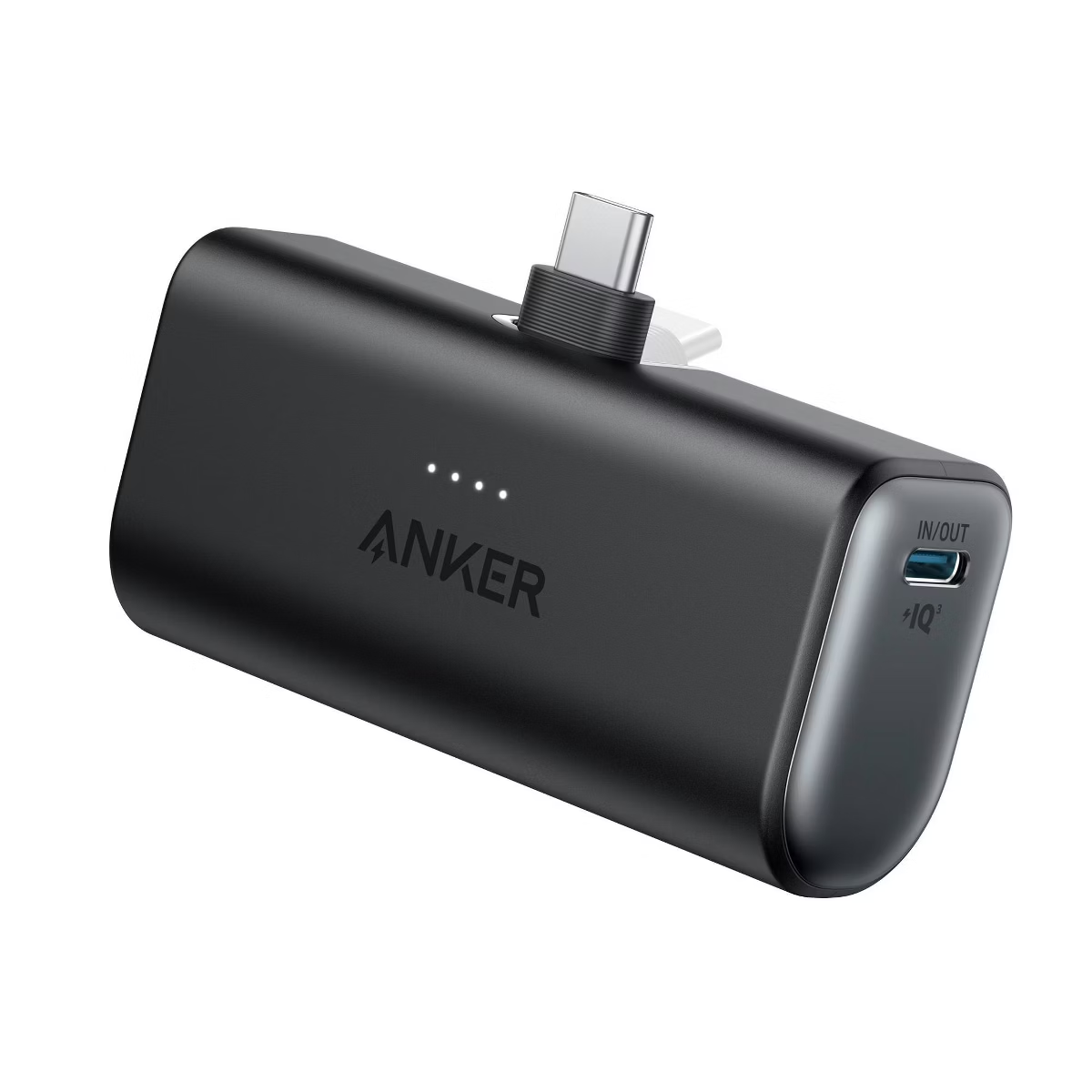
- Last year my phone battery was down to about 2% when I got to the end of the walk at Noordwijk. With another year on the clock, I didn’t think it would last the whole walk. I have a chonky 16000mAh battery pack, but it’s USB-A and heavy, and I didn’t want to weigh myself down with it. So I earlier in the week I bought a small and light and inexpensive (less than €20!) Anker Nano 5000mAh power bank. It has a built-in USB connector to attach to the charging port on the bottom of your phone, but it doesn’t hold on very securely and it looks dumb. It also has a standard USB port on its side, and that works just fine. This was just perfect to give me enough juice to last the full distance without worrying if I’d be able to still use my phone at the other end.